These are ten works of Renaissance architecture, sculpture and painting that I studied alongside my cultural overview of the Renaissance. For each one I describe what it shows, how the artist made it, and what it meant to the people who first saw it.
1. Dome of Florence Cathedral (Santa Maria del Fiore)
Filippo Brunelleschi, 1420-1436, brick and stone, Florence, Italy
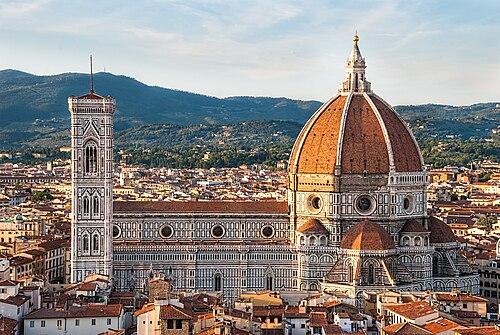
The dome sits on top of Florence's cathedral and is the largest brick dome ever built. It has eight sides, with white stone ribs running up red brick panels to a small marble lantern at the top. Brunelleschi built it without the huge wooden frame that builders normally used, which many people thought was impossible. He used two shells, an inner and an outer one, and laid the bricks in a herringbone pattern so they locked together as the dome rose. The ribs guide the eye upward to the lantern, which points toward heaven and reminds people that the building is a place of worship. The dome also became a symbol of Florence's pride and wealth, and it still rules the city's skyline today.
2. Holy Trinity
Masaccio, c. 1427, fresco, Santa Maria Novella, Florence, Italy
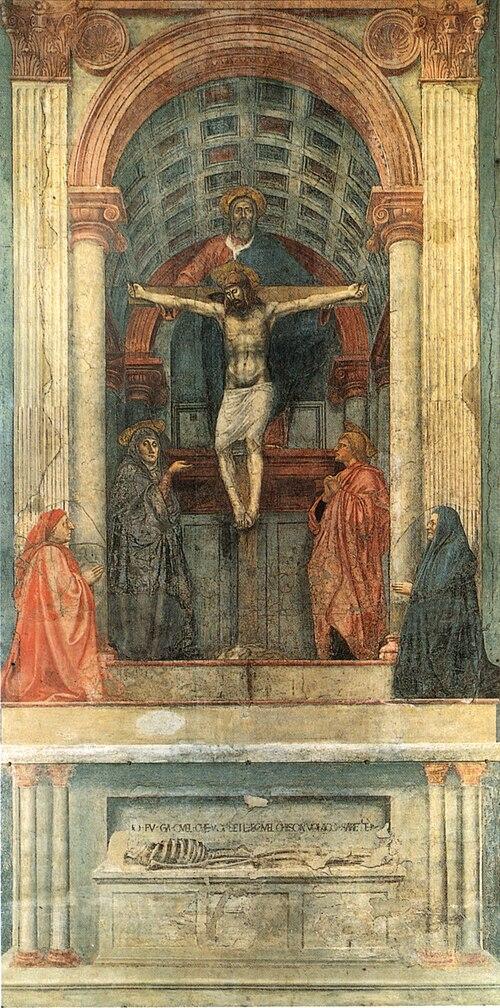
This fresco shows Christ on the cross with Heavenly Father standing behind him and the Holy Ghost as a white dove between them. Mary and John stand on each side, and the two people who paid for the painting kneel outside the frame. Masaccio painted a curved ceiling using linear perspective, so the flat wall looks like it opens into a real chapel. The lines of the ceiling meet near the viewer's eye level, which makes the scene feel like part of the viewer's own space. At the bottom is a skeleton lying on a tomb with words that say, "I was once what you are, and what I am you also will be." The painting moves from death at the bottom to Heavenly Father at the top, which teaches that faith in Christ leads from death to eternal life.
3. David
Donatello, c. 1440s, bronze, Museo Nazionale del Bargello, Florence, Italy
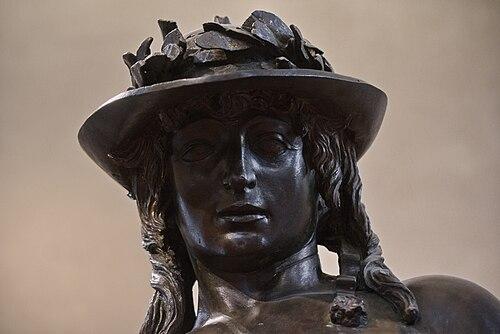
Donatello's David is a bronze statue of the young hero standing over the head of the giant Goliath after the battle. It was the first free-standing nude male statue made in Europe since ancient times. David wears only boots and a hat with a laurel wreath, and he holds Goliath's sword in his right hand and a stone in his left. He stands in contrapposto, with his weight on one leg, which gives him a relaxed and natural pose like ancient Greek statues. His calm face and young, slim body show that he was too small to win by strength alone, so his win came from faith. The statue stood in the courtyard of the Medici palace, where it showed Florence as a small city that could defeat bigger enemies.
4. The Birth of Venus
Sandro Botticelli, c. 1484-1486, tempera on canvas, Uffizi Gallery, Florence, Italy
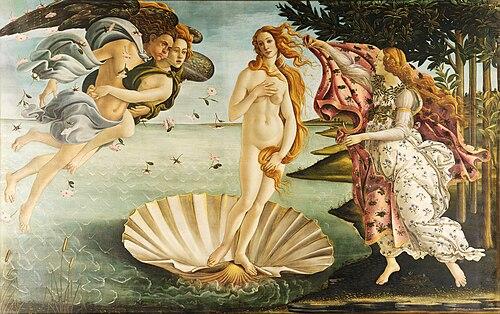
The painting shows Venus, the Roman goddess of love, arriving at the shore on a giant scallop shell. On the left, the wind god Zephyr and a female figure blow her toward land while roses fall around them. On the right, a woman waits to cover Venus with a cloak decorated with flowers. Venus stands in a curved pose based on ancient statues, and her long flowing hair and pale skin make her look calm and gentle. Botticelli used soft colors, strong outlines and very little shadow, which makes the scene feel more like a dream than real life. The painting brought back a myth from the ancient world, which shows the Renaissance love of classical stories and the idea that beauty can lead the mind to higher things.
5. The Last Supper
Leonardo da Vinci, c. 1495-1498, tempera and oil on plaster, Santa Maria delle Grazie, Milan, Italy
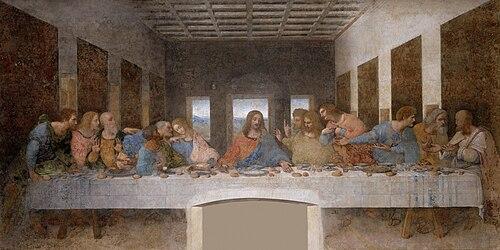
This mural shows Christ and his twelve Apostles at the moment he tells them that one of them will betray him. The Apostles react with shock and are placed in four groups of three, which creates movement across the table. Christ sits calmly in the center, and his body forms a triangle that makes him look stable and at peace. All the lines of the ceiling and walls lead to his head, so the viewer's eye goes straight to him. The window behind him frames his head with light, almost like a halo. Judas leans back into shadow while holding a small bag, which points to the money he took to betray Christ.
6. Mona Lisa
Leonardo da Vinci, c. 1503-1519, oil on poplar panel, Louvre Museum, Paris, France
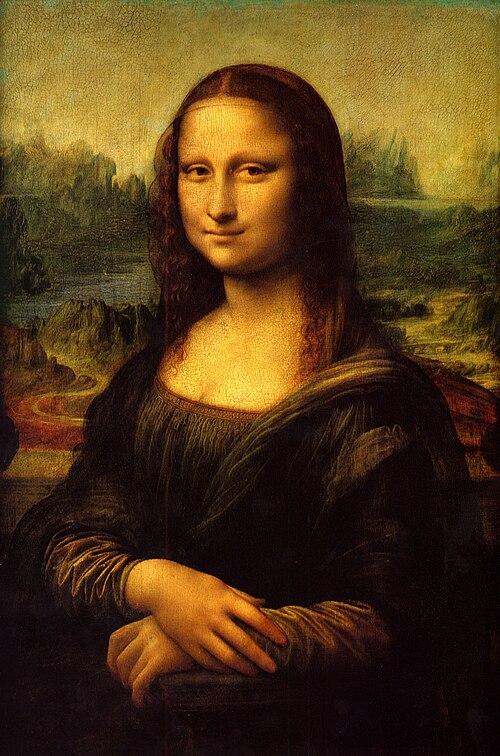
The Mona Lisa is a portrait of a woman, thought to be Lisa Gherardini, sitting with her hands folded in front of a wide landscape. Leonardo used a technique called sfumato, which blends colors and edges softly like smoke, especially around her eyes and mouth. This makes her smile hard to read, and it seems to change depending on where the viewer looks. Her body forms a pyramid shape, which makes the portrait feel steady and balanced. Behind her, the winding roads, river and blue mountains fade into the distance, which shows Leonardo's interest in nature and science. The painting shows the Renaissance focus on the individual, since a merchant's wife was painted with as much care as a saint.
7. David
Michelangelo Buonarroti, 1501-1504, marble, Galleria dell'Accademia, Florence, Italy
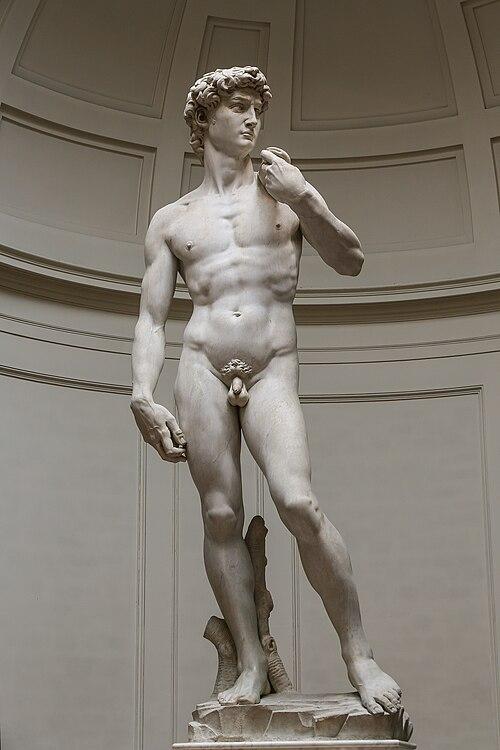
Michelangelo's David is a marble statue about 17 feet tall that shows the young hero before his fight with Goliath. Unlike Donatello's version, this David is a strong young man with a focused and worried look as he watches his enemy. He holds a sling over his left shoulder and a stone in his right hand. He stands in contrapposto, and his tense neck, raised brow and large hands show he is ready to act. The head and hands are larger than normal, possibly because the statue was first meant to be seen from below, high on the cathedral. The people of Florence placed it in front of the town hall, where it became a symbol of a small republic standing up to stronger rivals (Vasari).
8. The Creation of Adam
Michelangelo Buonarroti, c. 1508-1512, fresco, Sistine Chapel ceiling, Vatican City
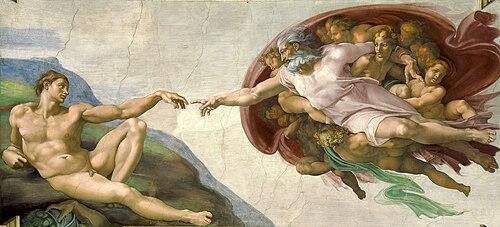
This scene is part of Michelangelo's Sistine Chapel ceiling and shows Heavenly Father giving life to Adam. Adam lies on the ground on the left, and his body looks weak as he lifts his hand. On the right, Heavenly Father flies toward him, wrapped in a red cloak and surrounded by angels. Their fingers almost touch, and the small gap between them is the focus of the whole painting. Adam's muscular body shows the Renaissance interest in the human form, which Michelangelo studied closely. The scene teaches that life comes from Heavenly Father, and the empty space between their hands shows the moment right before Adam receives it.
9. The School of Athens
Raphael, 1509-1511, fresco, Stanza della Segnatura, Vatican City
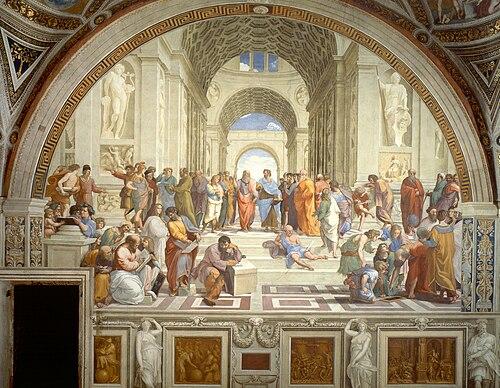
This fresco shows a gathering of famous ancient Greek thinkers inside a large building with tall arches. In the center, Plato points up to the sky while Aristotle holds his hand flat toward the ground, which shows their different ideas about where truth comes from. Plato holds his book Timaeus, and Aristotle holds his Ethics. Raphael used linear perspective so the arches and floor lines lead right to these two men. He also gave some thinkers the faces of artists from his time, such as Leonardo as Plato, and he painted himself near the right edge. The painting honors human learning and shows that Renaissance artists saw themselves as part of the same tradition as the ancient Greeks.
10. Arnolfini Portrait
Jan van Eyck, 1434, oil on oak panel, National Gallery, London, England
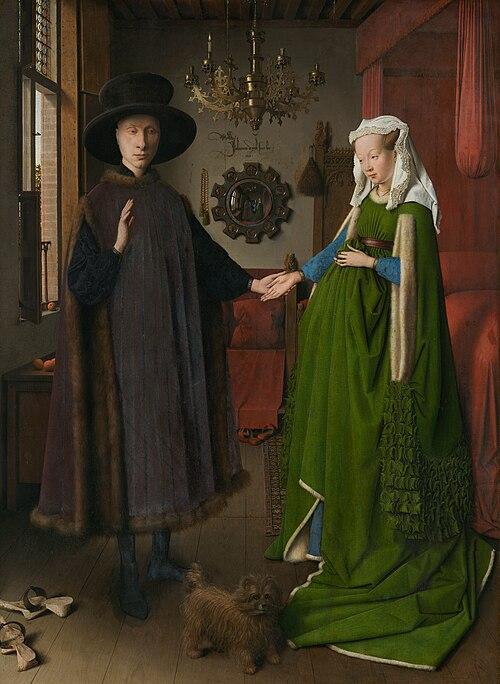
This painting is thought to show the Italian merchant Giovanni Arnolfini and his wife standing in a room in Bruges. Van Eyck used oil paint to show very small details, such as the fur on their clothes, the brass chandelier and the small dog. A round mirror on the back wall reflects two more people in the doorway, and above it the artist signed "Johannes de eyck fuit hic 1434," which means "Jan van Eyck was here." Many objects carry meaning, such as the dog for loyalty, the single lit candle for a holy presence, and the oranges for wealth since they were expensive imports. The rich clothes and imported items show the wealth that trade brought to Northern Europe. Because of this, the painting is both a portrait and a record of the merchant life that helped pay for Renaissance art.
Works Cited
Vasari, Giorgio. Lives of the Most Eminent Painters, Sculptors and Architects. 1550. Translated by Gaston du C. de Vere, Macmillan, 1912-1915.
Artwork images: Wikimedia Commons (public domain).