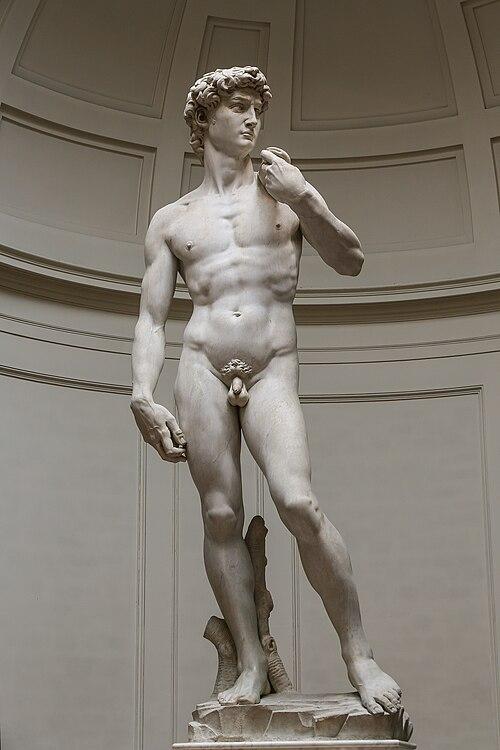
In 1501, a 26 year old Michelangelo began carving a giant block of marble that two other sculptors had given up on years before. Three years later, that block became the David, one of the most famous statues in the world. This shows what the Renaissance was about, which was people taking old ideas and turning them into something newer and better. The Renaissance, which means rebirth, was a period from about 1400-1600 when Europe renewed its interest in the art of ancient Greece and Rome ("Renaissance"). It changed how people saw art, faith, science, and money. In this essay I’ll address the Renaissance's unique historical and geographical contributions, its religious beliefs, its inventions and its commerce and banking.
The Renaissance started in Italy, in the 1400s and spread to the rest of Europe. Italy was a good place for it to begin because cities like Florence, Venice and Milan were rich from trade and banking. After the Black death killed about a third of europe's people in the mid 1300s, survivors had more land and money, and cities slowly grew again ("Renaissance"). Scholars like Petrarch started a movement called humanism, which was studying ancient writers and on what humans could achieve. In 1486, Giovanni Pico della Mirandola said that people were created with the freedom to shape their own lives, which basically sums up this new confidence (Pico della Mirandola). When the Ottoman turks took Constantinople in 1453, greek scholars fled to Italy and brought ancient texts with them, which added to this revival.
Religion was still at the center of life during the Renaissance, and the Catholic Church was the biggest institution in Europe. Popes and church leaders paid for many of the greatest artworks of the time, such as the Sistine Chapel ceiling. In 1517, Martin Luther posted his Ninety-Five Theses, which challenged the Church's sale of indulgences and started the Protestant Reformation (Luther). Reformers like William Tyndale also translated the Bible into common languages so regular people could read it. In our faith, we honor these reformers, and Elder M. Russell Ballard taught that men like Tyndale and Gutenberg "were prompted" in their work and that because of them "the Bible became a household possession" (Ballard). That access to the Bible helped prepare the way for Joseph Smith to read James 1:5 and seek the truth.
One of the biggest gifts of the Renaissance was the printing press, which Johannes Gutenberg developed in Mainz, Germany, around 1450. Before this, books were copied by hand and were rare and expensive, but by 1500 presses across Europe had printed millions of books (Eisenstein). This made it easier for ideas like humanism and the Reformation to spread quickly. Another gift was linear perspective, a way of making flat paintings look three dimensional. Filippo Brunelleschi worked out the method in the early 1400s, and Leon Battista Alberti explained it for other artists in his book On Painting in 1435 (Alberti). Artists such as Masaccio and Raphael used it to make space in their paintings feel real, and it is still the base of drawing and design today.
As a business management student who works with affiliate partners and profit margins, I find the Renaissance economy and especially Medici banking interesting. Giovanni di Bicci de' Medici founded the Medici Bank in Florence in 1397, and it grew to have branches in cities like Rome, Venice, Geneva, Bruges and London (de Roover). Each branch was run by a manager who was a partner and shared in the profits, which gave him a reason to work hard while the Medici kept control. Since the Church banned charging interest, the bank made money through bills of exchange, which let merchants move money between cities and currencies (de Roover). The bank also served as the pope's banker, and its profits helped the Medici pay for artists like Botticelli and Michelangelo. This reminds me of my own work where I manage partners and watch margins, because good results come when both sides share in the success.
Works Cited
Alberti, Leon Battista. On Painting. 1435. Translated by John R. Spencer, Yale UP, 1956.
Ballard, M. Russell. "The Miracle of the Holy Bible." General Conference, Apr. 2007, The Church of Jesus Christ of Latter-day Saints, www.churchofjesuschrist.org/study/general-conference/2007/04/the-miracle-of-the-holy-bible.
de Roover, Raymond. The Rise and Decline of the Medici Bank, 1397-1494. Harvard UP, 1963.
Eisenstein, Elizabeth L. The Printing Revolution in Early Modern Europe. Cambridge UP, 1983.
Luther, Martin. The Ninety-Five Theses. 1517.
Pico della Mirandola, Giovanni. Oration on the Dignity of Man. 1486. Translated by A. Robert Caponigri, Regnery, 1956.
"Renaissance." Encyclopaedia Britannica, www.britannica.com/event/Renaissance. Accessed 12 Oct. 2026.